
Your CIBIL Score is one of the most important numbers in your credit profile. Banks and other lenders can use your credit history and CIBIL Score while evaluating applications for loans and credit cards.
But one question many borrowers have is:
How is CIBIL Score actually calculated?
The answer is more detailed than simply adding up your loan payments or dividing your outstanding balance by your credit limit.
TransUnion CIBIL states that an individual’s CIBIL Score is a three-digit summary of credit history, ranging from 300 to 900. The score is derived from information in the Accounts and Enquiries sections of the CIBIL Credit Information Report (CIR). CIBIL also says that its scoring algorithm is proprietary, so there is no publicly available formula that lets consumers calculate their exact score manually.
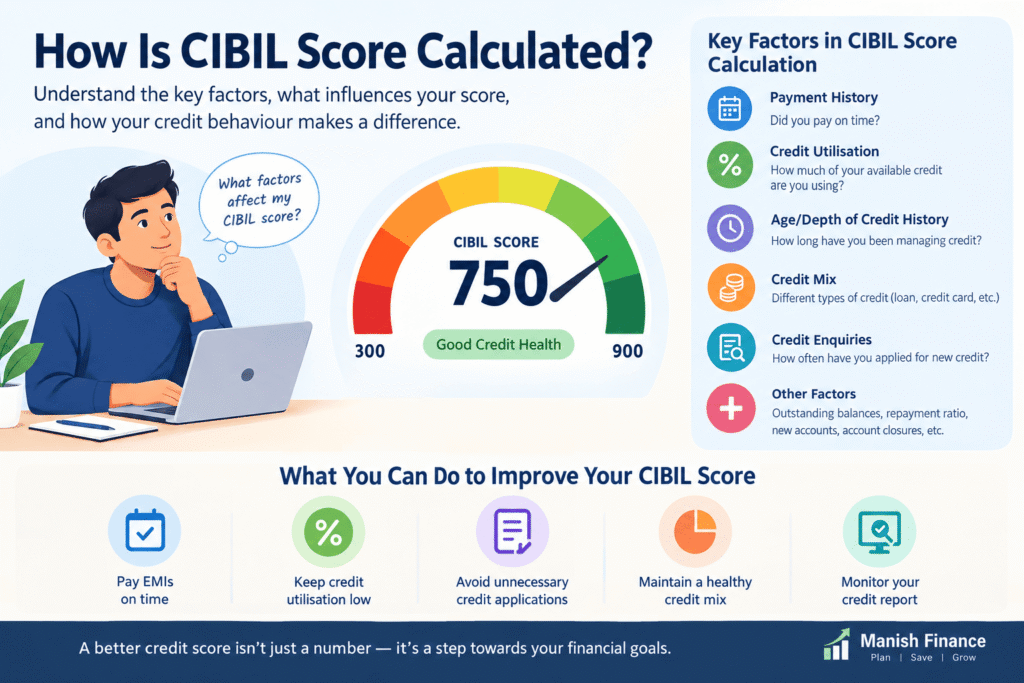
However, CIBIL identifies several major factors that influence the score, including payment history, credit utilisation, age/depth of credit, credit mix and credit enquiries.
This guide explains these factors in detail and shows how different credit behaviours can affect your CIBIL Score.
What Is a CIBIL Score?
A CIBIL Score is a three-digit numerical summary of your credit history.
The score generally ranges from:
300 to 900
A score closer to 900 indicates a stronger credit history from a lender’s perspective. CIBIL says that a higher score can improve the chances of a loan or credit-card application being approved, although the final lending decision is made by the lender, not by CIBIL.
Your CIBIL Score is created from information reported by banks and financial institutions.
This can include information related to:
- Credit cards
- Personal loans
- Home loans
- Automobile loans
- Overdraft facilities
- Other reported credit facilities
- Repayment history
- Outstanding balances
- Credit enquiries
- Account opening and closing information
CIBIL’s report contains a record of your credit accounts and repayment behaviour reported by participating lenders.
CIBIL Score vs CIBIL Report
These two terms are often confused.
CIBIL Score:
A three-digit number summarising your credit history.
CIBIL Report:
A detailed record containing information about your credit accounts, payment history, enquiries and other credit-related information.
Think of the report as the detailed record and the score as a numerical summary of important credit behaviour reflected in that record.
How Is CIBIL Score Calculated?
There is no publicly disclosed formula such as:
CIBIL Score = 30% payment history + 25% utilisation + 25% credit age + 20% enquiries
You may see percentage-based formulas like this on various websites, but consumers should not treat them as CIBIL’s official calculation formula.
CIBIL says its score is calculated using a proprietary algorithm.
Instead of relying on a simple publicly disclosed formula, it is more accurate to understand the major categories of information that influence your score.
The major factors include:
- Payment history
- Credit utilisation
- Age/depth of credit history
- Credit mix
- Credit enquiries
- Outstanding balances and repayment patterns
- Number of new accounts
- Account closures and overall credit behaviour
Let’s examine each one.
1. Payment History
Payment history is one of the most important parts of your credit profile.
It answers a basic question:
When you borrowed money, did you repay it as agreed?
CIBIL explains that payment history reflects whether payments were made on time and in full. Late payments, missed payments and delinquencies can negatively affect the score.
Example
Suppose you have a personal loan EMI of ₹10,000.
If you regularly pay the EMI by the due date, your credit report can demonstrate a consistent repayment pattern.
But if payments are repeatedly late or remain overdue, lenders may see a higher repayment risk.
What can appear in payment history?
Your credit report may contain month-by-month repayment information reported by lenders.
Depending on the account and reporting information, it can show whether payments were:
- On time
- Delayed
- Overdue
- Partially paid
- Missed
- In default
CIBIL also notes that the magnitude of overdue amounts and other characteristics of payment behaviour can affect the score.
Why even one late payment matters
A late payment does not necessarily mean your score will permanently remain low.
However, a missed or delayed payment can become part of your credit history and may affect how lenders view your repayment behaviour.
Repeated late payments are particularly problematic because they demonstrate a pattern rather than an isolated event.
Credit card payment example
Suppose your credit card bill is:
Total amount due: ₹20,000
You have the ability to pay the full amount.
Paying the bill on time and in full demonstrates responsible repayment behaviour.
If you repeatedly miss payments or leave amounts overdue, that can negatively affect your credit profile.
2. Credit Utilisation Ratio
Credit utilisation is another important factor.
It generally refers to how much of your available revolving credit you are using.
For example:
Credit limit = ₹1,00,000
Outstanding balance = ₹30,000
Your utilisation is:
₹30,000 ÷ ₹1,00,000 × 100 = 30%
So your credit utilisation for that balance is 30%.
CIBIL states that higher credit utilisation can indicate a greater repayment burden and may negatively affect the score.
Why utilisation matters
Imagine two people have the same credit limit of ₹1 lakh.
Person A uses ₹20,000.
Person B uses ₹95,000.
Even though both have the same total limit, Person B is using substantially more of the available revolving credit.
High utilisation can therefore be an important signal in the credit profile.
Does using a credit card automatically hurt your CIBIL Score?
No.
Simply using a credit card is not inherently negative.
The important considerations include:
- How much available credit is being used
- Whether payments are made on time
- Whether balances remain outstanding
- The overall credit profile
CIBIL recommends keeping balances low and controlling credit utilisation.
3. Age or Depth of Credit History
Another factor is the length or depth of your credit history.
In simple terms:
How long have you been managing credit?
For example, imagine two borrowers.
Borrower A
Oldest credit account: 7 years ago
Borrower B
Oldest credit account: 6 months ago
Borrower A has a much longer credit history.
CIBIL’s guidance identifies the depth of credit, including the duration of existing credit history calculated from the date the oldest credit account was opened, as a factor that can affect the score.
A longer history can give lenders more information about how you have managed credit over time.
Why closing an old credit card may matter
Suppose you have an old credit card that has been active for many years.
If you close it, your credit profile may change because the account is no longer active.
However, whether closing an account is appropriate depends on your individual circumstances.
You should not keep an unsuitable or expensive credit product solely because it is old.
The important point is that the age and depth of your credit history are part of the information considered in credit scoring.
4. Credit Mix
Credit mix refers to the different types of credit in your credit profile.
For example, your credit history could include:
- Home loan
- Auto loan
- Personal loan
- Credit card
CIBIL identifies maintaining a healthy mix of secured and unsecured credit as one factor relevant to credit health.
Secured vs unsecured credit
Secured credit is generally backed by an asset.
Examples:
- Home loan
- Vehicle loan
Unsecured credit generally does not require collateral.
Examples:
- Personal loan
- Credit card
A healthy credit profile can contain different types of credit, but this does not mean you should take loans you do not need just to create a “credit mix.”
Borrowing money unnecessarily can increase your financial obligations.
5. Credit Enquiries
Every time you apply for certain types of credit, a lender may access your credit report.
This can create a credit enquiry.
CIBIL’s report includes lender enquiries made for loan and credit-card applications, and CIBIL identifies multiple enquiries as a factor that can negatively affect the score.
Example
Imagine you apply for:
- Personal loan from Bank A
- Personal loan from Bank B
- Credit card from Bank C
- Personal loan from NBFC D
within a short period.
Several lenders may check your credit profile.
A large number of recent enquiries can indicate that you are actively seeking additional credit.
Does checking your own CIBIL Score reduce your score?
Checking your own credit report is different from applying for credit.
CIBIL provides consumers with access to their own credit information, and the enquiries section records lender enquiries.
So consumers should distinguish between:
Self-checking your credit report
and
A lender making a credit enquiry when evaluating an application.
6. Outstanding Balances
Your outstanding balances can also influence your credit profile.
Suppose you have several credit accounts:
| Account | Credit/Loan Amount | Outstanding |
|---|---|---|
| Credit Card A | ₹1,00,000 limit | ₹70,000 |
| Credit Card B | ₹50,000 limit | ₹40,000 |
| Personal Loan | ₹3,00,000 original loan | ₹2,20,000 |
This shows that you currently have substantial outstanding obligations.
CIBIL’s published guidance says factors such as long-term trends in outstanding balances can affect the CIBIL Score.
The important point is that the score isn’t simply looking at whether you have borrowed money.
It considers patterns in how you have used and repaid credit.
7. Ratio of Repayment to Amount Due
CIBIL’s consumer guidance also identifies the ratio of actual repayment amount to total amount due as one of the factors that can affect the score.
This is especially relevant when looking at repayment behaviour.
For example:
If a borrower consistently pays only a small portion of the amount due while balances continue accumulating, the credit profile may look different from someone who consistently pays their obligations in full.
Again, there is no publicly disclosed formula that lets you convert this behaviour directly into a specific number of CIBIL points.
8. Number of New Accounts
CIBIL’s published information also identifies the number of new accounts opened and accounts closed as factors that can affect the score.
Opening several credit accounts within a short period can change your credit profile.
For example:
You apply for five credit cards within two months.
That may result in:
- Multiple lender enquiries
- Several new accounts
- Additional available credit
- Potentially higher total borrowing
- A shorter average account age
These changes can influence your overall credit profile.
Is There a Fixed CIBIL Score Formula?
No publicly disclosed consumer formula should be treated as the official CIBIL Score calculation formula.
This is one of the most important points to understand.
CIBIL describes its scoring method as proprietary.
Therefore, you cannot accurately calculate your CIBIL Score using a simple calculator such as:
Payment history × 30%
Utilisation × 25%
Credit age × 25%
Enquiries × 20%
Such percentages may appear in third-party articles, but they should not be presented as the official CIBIL formula unless CIBIL itself has published that exact methodology.
What can you calculate yourself?
You can calculate individual indicators.
For example:
Credit utilisation = Outstanding revolving balance ÷ Total available revolving credit × 100
But you cannot use that result, along with a few other percentages, to reproduce your exact CIBIL Score.
A Practical Example of CIBIL Score Calculation
Let’s imagine a fictional borrower named Rahul.
Rahul has:
- One credit card
- One personal loan
- One vehicle loan
- Five years of credit history
- No recent missed EMI
- Moderate credit utilisation
- Two recent credit enquiries
His profile could look like this:
| Factor | Rahul’s Profile |
|---|---|
| Payment history | Regular |
| Credit utilisation | Moderate |
| Credit history | 5 years |
| Credit mix | Multiple credit types |
| Recent enquiries | 2 |
| Outstanding balances | Moderate |
Rahul may have a healthy credit profile.
But we cannot calculate his exact CIBIL Score from this information alone.
Why?
Because the actual scoring system uses a proprietary algorithm and the information reported in his credit file.
This is why two people with seemingly similar credit behaviour can have different scores.
Does Salary Affect CIBIL Score?
Your salary itself is not the same thing as your credit score.
CIBIL explains that the report contains information such as employment information when reported by members, but the CIBIL Score is derived from credit-history information in the relevant sections of the report.
For example:
Person A
Salary: ₹1,00,000/month
Poor repayment history
Person B
Salary: ₹40,000/month
Consistently manages credit responsibly
A higher salary does not automatically guarantee a higher CIBIL Score.
This is because credit scoring focuses heavily on credit behaviour and history.
Does Having a Bank Account Improve CIBIL Score?
Simply having a savings account does not automatically create a high CIBIL Score.
CIBIL says its report is based on credit history and does not contain details of savings, investments or fixed deposits as part of the credit history used to generate the score.
Credit cards and loans are examples of products that can create credit history when reported by lenders.
Does Having No Loan Mean You Have a 900 CIBIL Score?
No.
Having no credit history is not the same as having an excellent credit history.
Some people with limited or no reported credit history may see NA/NH rather than a conventional numerical score, depending on their credit profile. CIBIL provides specific explanations for why NA/NH can appear.
This is why building a responsible credit history is different from simply avoiding all credit.
Why Can Your CIBIL Score Change Even If You Did Nothing Wrong?
Your CIBIL Score can change as new information is reported to CIBIL.
For example, your lender may report:
- A new payment
- A new balance
- A new enquiry
- A newly opened account
- An account closure
- Updated repayment information
CIBIL’s report is compiled from information supplied by banks and financial institutions.
Therefore, your score can change as your credit information changes.
How Often Does CIBIL Update Your Credit Information?
Banks and financial institutions provide credit information to credit bureaus as part of their reporting processes.
Your report therefore changes as lenders provide updated information.
This means there can be a delay between:
What happens with your loan/card
and
What appears in your credit report.
For example, if you recently paid an outstanding amount, you should not necessarily expect the credit report to change immediately.
The reporting cycle and lender’s submission process matter.
Does Paying a Loan Early Improve CIBIL Score?
Early repayment is not automatically equivalent to a higher score.
The effect depends on the overall credit profile and how the account is reported.
If you close a loan, your credit profile may change because:
- The account becomes closed
- Outstanding balance changes
- Your active credit mix changes
- Your total outstanding debt changes
Therefore, it is better to view early repayment as a financial decision rather than a guaranteed credit-score strategy.
Does Closing a Credit Card Reduce CIBIL Score?
Closing a credit card does not have a universal, guaranteed effect such as “closing a card reduces your score by 20 points.”
The impact can depend on the rest of your credit profile.
For example, closing a card may change:
- Available credit
- Credit utilisation
- Number of active accounts
- Age/depth of credit history
- Overall credit mix
Therefore, the effect should be considered in context.
How Credit Utilisation Can Change Your Profile
Consider a credit card with a ₹1,00,000 limit.
Scenario 1
Outstanding = ₹10,000
Utilisation:
10%
Scenario 2
Outstanding = ₹50,000
Utilisation:
50%
Scenario 3
Outstanding = ₹90,000
Utilisation:
90%
The three situations represent very different levels of available credit usage.
CIBIL advises consumers to control their utilisation and keep balances low.
However, there is no official CIBIL rule saying that a specific utilisation percentage will automatically produce a specific score.
What Happens If You Miss an EMI?
A missed or late EMI can negatively affect your credit profile.
CIBIL specifically identifies late payments, missed payments and delinquencies as negative factors.
The potential impact can depend on factors such as:
- How late the payment was
- Whether it was reported
- The amount overdue
- Whether similar incidents occurred previously
- Your broader credit history
Therefore, missing an EMI should be taken seriously.
What Happens If You Default on a Loan?
A default can be considerably more serious than a minor delay because it can indicate a failure to repay according to the agreed terms.
Your credit report may reflect negative repayment information reported by the lender.
A history containing serious delinquencies can make future borrowing more difficult.
The exact effect on your score cannot be predicted using a simple fixed number because CIBIL’s scoring methodology is proprietary.
Do Multiple Credit Cards Improve CIBIL Score?
Simply having more credit cards does not automatically increase your CIBIL Score.
For example:
Having five credit cards with:
- High utilisation
- Multiple recent applications
- Missed payments
would not necessarily create a stronger credit profile.
What matters is how credit is managed.
A person with fewer accounts but responsible repayment behaviour may have a healthier credit profile than someone who has many accounts but struggles to manage them.
Does Using a Credit Card Build CIBIL Score?
Responsible use of credit can help establish a credit history.
For example:
- Use the card for planned purchases.
- Keep balances manageable.
- Pay dues on time.
- Avoid unnecessary applications.
- Monitor your credit report.
CIBIL states that timely repayment of credit-card bills and loan EMIs helps demonstrate responsible credit management.
CIBIL Score Ranges: What Do They Mean?
CIBIL scores range from 300 to 900.
People often divide scores into bands for convenience, but there is an important distinction:
A score band is not the same thing as a guaranteed lending decision.
For example, CIBIL’s consumer material states that a score above 700 is generally considered good.
However, lenders consider more than the score itself.
They may also evaluate:
- Income
- Employment
- Existing liabilities
- Loan amount
- Repayment capacity
- Relationship with the lender
- Internal lending policies
- Credit report details
Therefore:
A high CIBIL Score does not guarantee loan approval.
CIBIL itself states that the final decision to sanction a loan or credit card belongs to the lender.
Why Two People With Similar Scores Can Get Different Loan Offers
Credit score is only one part of a lending decision.
Imagine two people both have a CIBIL Score of 780.
Person A:
- Stable income
- Low existing debt
- Low credit utilisation
- Strong repayment capacity
Person B:
- High existing EMIs
- Large outstanding debt
- Lower repayment capacity
A lender could evaluate these two borrowers differently despite the same score.
This demonstrates why the CIBIL Score should not be treated as a complete financial profile.
What Information Does CIBIL Use?
The CIBIL Report can contain information relating to:
Personal Information
Such as:
- Name
- Date of birth
- Identification information
Contact Information
Such as reported addresses and telephone numbers.
Employment Information
Employment/income information reported by members may appear in the report.
Account Information
This can include:
- Lender name
- Account type
- Account number
- Ownership
- Date opened
- Loan amount
- Current balance
- Payment information
Enquiry Information
The report can show lender enquiries associated with applications for credit.
CIBIL describes these sections as part of its Credit Information Report.
How to Improve the Factors That Influence Your CIBIL Score
There is no legitimate shortcut that guarantees an immediate increase in your CIBIL Score.
Instead, focus on consistent credit management.
1. Pay EMIs on time
Avoid missed or delayed payments.
CIBIL explicitly recommends paying dues on time.
2. Keep credit utilisation under control
Avoid consistently using a very large portion of your available revolving credit.
3. Avoid unnecessary credit applications
Applying for many loans or credit cards within a short period can create multiple enquiries.
4. Maintain a healthy credit mix
A balanced credit profile can be beneficial, but you should never borrow unnecessarily simply to create a credit mix.
5. Monitor your credit report
Regularly reviewing your credit information can help you identify:
- Incorrect account information
- Unrecognised enquiries
- Incorrect overdue amounts
- Accounts that do not belong to you
- Incorrect personal details
CIBIL recommends checking your score and report so that you can identify errors and monitor your credit health.
What If There Is an Error in Your CIBIL Report?
Credit-report errors can be important because your score is based on information in your credit report.
Suppose your report incorrectly shows:
₹50,000 overdue
when you actually paid the amount.
You should investigate the information and follow the appropriate dispute process with CIBIL and/or the lender that supplied the information.
Examples of information you might check include:
- Incorrect payment status
- Wrong account ownership
- Incorrect outstanding balance
- Unknown credit enquiry
- Incorrect personal information
Do not ignore an error simply because your current score looks acceptable.
Common Myths About CIBIL Score Calculation
Myth 1: “CIBIL publishes a fixed 30-25-25-20 formula.”
Reality: CIBIL describes its scoring algorithm as proprietary. The exact formula is not publicly disclosed.
Myth 2: “A salary increase automatically increases CIBIL Score.”
Reality: CIBIL Score is primarily based on credit history and behaviour reflected in the credit report.
Myth 3: “Checking my own CIBIL Score lowers my score.”
Reality: A consumer checking their own report is different from lender enquiries associated with applications for credit.
Myth 4: “Having many credit cards automatically improves CIBIL.”
Reality: The number of cards alone does not guarantee a higher score.
Myth 5: “No loans means a perfect CIBIL Score.”
Reality: A person with little or no reported credit history may have limited credit information or may receive an NA/NH result rather than a conventional high score.
Myth 6: “Closing a credit card always destroys CIBIL Score.”
Reality: The effect of closing an account depends on the individual’s broader credit profile.
Myth 7: “CIBIL approves or rejects loans.”
Reality: CIBIL provides credit information and scores. The lender makes the final lending decision.
CIBIL Score Calculation: The Simple Formula You Should Remember
Although you cannot calculate the exact CIBIL Score yourself, you can remember this framework:
CIBIL Score = Credit behaviour + repayment history + credit utilisation + credit history + enquiries + overall credit profile
This is a conceptual explanation, not CIBIL’s official mathematical formula.
The actual score is generated through CIBIL’s proprietary scoring system using information in your credit report.
A Simple CIBIL Score Example
Let’s consider three fictional borrowers.
| Factor | Amit | Ravi | Neha |
|---|---|---|---|
| Payment history | Regular | Several late payments | Regular |
| Credit utilisation | Moderate | Very high | Low |
| Credit history | Long | Short | Medium |
| Recent enquiries | Few | Many | Few |
| Outstanding debt | Moderate | High | Low |
| Credit mix | Balanced | Mostly unsecured | Mixed |
These profiles demonstrate why a credit score cannot be determined from one factor alone.
The actual score depends on the information contained in each person’s credit file and CIBIL’s proprietary scoring methodology.
Frequently Asked Questions
How is CIBIL Score calculated?
CIBIL Score is calculated from credit-history information contained in the CIBIL Credit Information Report, particularly information in the Accounts and Enquiries sections. CIBIL uses a proprietary scoring algorithm.
What is the CIBIL Score range?
CIBIL Scores range from 300 to 900.
What factors affect CIBIL Score?
Major factors include payment history, credit utilisation, age/depth of credit, credit mix and credit enquiries. Other reported characteristics such as outstanding balances, repayment ratios, new accounts and account closures can also affect the score.
Does paying EMI on time increase CIBIL Score?
Consistently paying EMIs and other credit dues on time helps establish responsible repayment behaviour and supports a healthy credit history.
Does credit card utilisation affect CIBIL Score?
Yes. CIBIL identifies credit utilisation as a factor that can affect the score. Higher utilisation may negatively affect the score.
Does closing a loan affect CIBIL Score?
Closing a loan changes your credit profile because the account status, outstanding balance and active credit mix change. The effect on the score depends on your overall credit history.
Does salary affect CIBIL Score?
Salary itself is not a direct substitute for credit history. The CIBIL Score is derived from credit-related information reported in your credit file.
Can I calculate my exact CIBIL Score manually?
No. You can calculate individual indicators such as credit utilisation, but CIBIL’s exact scoring algorithm is proprietary, so an exact score cannot be reproduced using a publicly available formula.
Does checking my own CIBIL Score reduce it?
Checking your own credit information should be distinguished from lender enquiries made during credit applications. CIBIL’s report separately records lender enquiries.
How long does it take to improve CIBIL Score?
There is no universal number of days or months because changes depend on your individual credit history, lender reporting and subsequent credit behaviour.
Final Takeaway
Understanding how CIBIL Score is calculated is less about finding a secret mathematical formula and more about understanding how your credit behaviour is recorded.
The most important areas to watch are:
- Payment history
- Credit utilisation
- Age/depth of credit history
- Credit mix
- Credit enquiries
- Outstanding balances
- New accounts
- Overall repayment behaviour
CIBIL’s exact scoring algorithm is proprietary, so no third-party calculator can accurately reproduce your exact CIBIL Score merely from a few inputs.
The practical lesson is simple:
Build a consistent credit history, pay your dues on time, manage credit utilisation responsibly, avoid unnecessary applications, and regularly check your credit report for errors.
A CIBIL Score is a summary of past credit behaviour—not a permanent label. Responsible credit management over time can help you maintain a healthier credit profile.